What has traditionally been the primary means of making money by McDonald’s corporation? Most of us wouldn’t have to think much before answering that its hamburgers, fries and the fast food items that have been responsible for the genesis of the fast food nation. When I read “Rich Dad, Poor Dad”, it gave a different picture. It said that the primary business was real estate. I couldn’t really understand the logic then, but I have a slightly better picture now.
I am currently reading “Mc Donald’s Behind the Arches”, and am thrilled to know the strategy behind making money by the company. Ray Kroc, a consummate salesman, had total control over the operations, and believed that money will follow. But the $950 franchising fees and the 1.9% of the sales didn’t do much to add value to the corporation. It was the acumen of the behind the scenes Sonneborn who could leverage the successful McDonald’s operations to make money in a way not many can imagine. By leasing out land / real estate to franchisees at 20% and then 40% markup it ensured a constant inflow of cash. While it solved the problem of the smaller franchisees (who were individuals starting off a business with their accumulated life’s savings), it also made sure the corporation made money.
The scheme was simple: the company would take a long term lease over a piece of lucrative land and then sub lease it to the operator. And the company had the rights to terminate the contract should things not go as Kroc wanted. In course of time, Mc Donald’s corporation started buying land and leased them out to the franchisees. This was executed by a separate real estate company, called Franchise Realty Corporation. So while the parent company was virtually a cost center, the realty company was the real profit center.
For such schemes and agreements to come to India would require a considerable amount of maturity in the Indian markets. In the two MNC IT companies I have worked for, the premises have been leased, and so the company only pays a rent on it, without locking in capital. Perhaps it makes sense for them, given that they are in no business of real estate, and would not like to end up like Enron (that had numerous non performing assets taking up space in its balance sheet, before the tweaking started).
Indian companies have traditionally been self sufficient. Particularly in the manufacturing sector, companies have bought land from the government and developed their factories. There wasn’t any one who could lease the land out to them. But now that India is witnessing a real estate boom, a steady growth of over 8%, a lot of direct investment from overseas, it is a signal that markets are maturing. I read about a new avenue of joining the bandwagon. The corporates could use the sale-leaseback to unlock capital and get more funds for their primary business. And this capital put in their core business could translate into high ROI. Sale-leaseback transaction is a technique used by corporations to raise capital, increase shareholder value and remove the real estate assets from their balance sheet. This gives operational control over the assets to the corporations.
Why would an investor put in money? The way Mc Donald’s corporation is making money, investors (realty MFs, FIIs, corporations interested in venturing into realty) could expect steady returns. They could have a right risk return trade off by giving it out to credit worthy tenants.
This transaction, even though currently not too popular, is fast catching up. We might find more companies selling off their land and leasing it back to have more control over their capital.
Sunday, December 17, 2006

Thursday, December 07, 2006
Larry Summers
>From a business standard article
The argument that globalisation is inevitable and protectionism is counterproductive does not provide much consolation for the losers.
Against all odds, we are living in a time of plenty. Neither the after-effects of September 11 2001 nor a tripling in oil prices has prevented the world's economy from growing faster in the past five years than in any five-year period in recorded economic history.
Given this recent performance and the pricing-in by world markets of an optimistic outlook, one might have expected this to be a moment of particularly great enthusiasm for the market system and for global integration.
Yet in many corners of the globe there is growing disillusionment. From the failure to complete the Doha trade round to pervasive Wal-Mart-bashing, from massive renationalisation in Russia to the success of populists in Latin America and eastern Europe, we see a degree of anxiety about the market system that is unmatched since the fall of the Berlin Wall and probably well before.
Why is there such disillusionment? Some anti-globalisation sentiment can be seen as a manifestation of resistance to the US arising from the Bush administration's foreign policy misadventures. But there is a much more troubling source: the growing recognition that the vast global middle is not sharing the benefits of the current period of economic growth—and that its share of the pie may even be shrinking.
Two groups have found themselves in the right place at the right time to benefit from globalisation and technological change. First, those in low-income countries, principally in Asia and especially in China, who are able to plug into the global system. The combination of low wages, diffusible technology and the ability to access global product and financial markets has fuelled an economic explosion.
It is important to remember that the period between the late 18th and early 19th centuries in Britain and continental Europe was called the Industrial Revolution for a reason. For the first time in human history, the standard of living of one generation was demonstrably better than the one before: in a single lifespan, real per capita incomes doubled and then doubled again. If one looks at the growth rate of China during the past 30 years, living standards are increasing at a rate that will lead to a hundred-fold improvement over a single human lifespan. The impact cannot be overstated.
Second, it has been a golden age for those who already own valuable assets. Owners of scarce commodities have seen their returns rise prodigiously. People running businesses that can take advantage of globalisation to source labour less expensively and sell to larger markets have seen their incomes rise far faster than incomes generally. Certainly those in the financial sector in a position to benefit from the asset revaluations associated with globalisation have prospered.
Everyone else has not fared nearly as well. As the great corporate engines of efficiency succeed by using cutting-edge technology with low-cost labour, ordinary, middle-class workers and their employers—whether they live in the American midwest, the Ruhr valley, Latin America or eastern Europe—are left out. This is the essential reason why median family incomes lag far behind productivity growth in the US, why average family incomes in Mexico have barely grown in the 13 years since the North American Free Trade Agreement passed, and why middle-income countries without natural resources struggle to define an area of comparative advantage.
It is this vast group that lacks the capital to benefit from globalisation and is desperately seeking either reassurance or a change in course. Yet without its support it is very doubtful that the existing global economic order can be maintained.
Let us be frank. What the anxious global middle is told often feels like pretty thin gruel. The twin arguments that globalisation is inevitable and protectionism is counterproductive have the great virtue of being correct, but do not provide much consolation for the losers. Nor can they rally support for policies that maintain, let alone promote, international integration.
Economists rightly emphasise that trade, like other forms of progress, makes everyone richer by enabling them to buy goods at lower prices. But this offers small solace to those who fear their jobs will vanish.
Education is central to any economic strategy, but there is a limit to what it can do for workers in their 40s and beyond. Nor can education be a complete answer at a time when skilled computer programmers in India are paid less than $2,000 a month.
John Kenneth Galbraith was right when he observed: "All of the great leaders have had one characteristic in common: it was the willingness to confront unequivocally the major anxiety of their people in their time. This, and not much else, is the essence of leadership." Meeting the needs of the anxious global middle is the economic challenge of our time.
In the US, the political pendulum is swinging left. The best parts of the progressive tradition do not oppose the market system; they improve on the outcomes it naturally produces. That is what we need today.
There are no easy answers. The economic logic of free, globalised, technologically sophisticated capitalism may well be to shift more wealth to the very richest and some of the very poorest in the world, while squeezing people in the middle.
Just as the Federal Housing Administration's effort to make owner-occupied housing more available after the second world war was a crucial part of the policy approach that permitted the Marshall Plan to go forward, so also our success in advancing international integration will depend on what can be done for the great global middle.
Our response will affect not just the livelihoods of millions of our fellow citizens but also the prospects for continuing global integration, with all the prosperity and stability it has the potential to bring.
The argument that globalisation is inevitable and protectionism is counterproductive does not provide much consolation for the losers.
Against all odds, we are living in a time of plenty. Neither the after-effects of September 11 2001 nor a tripling in oil prices has prevented the world's economy from growing faster in the past five years than in any five-year period in recorded economic history.
Given this recent performance and the pricing-in by world markets of an optimistic outlook, one might have expected this to be a moment of particularly great enthusiasm for the market system and for global integration.
Yet in many corners of the globe there is growing disillusionment. From the failure to complete the Doha trade round to pervasive Wal-Mart-bashing, from massive renationalisation in Russia to the success of populists in Latin America and eastern Europe, we see a degree of anxiety about the market system that is unmatched since the fall of the Berlin Wall and probably well before.
Why is there such disillusionment? Some anti-globalisation sentiment can be seen as a manifestation of resistance to the US arising from the Bush administration's foreign policy misadventures. But there is a much more troubling source: the growing recognition that the vast global middle is not sharing the benefits of the current period of economic growth—and that its share of the pie may even be shrinking.
Two groups have found themselves in the right place at the right time to benefit from globalisation and technological change. First, those in low-income countries, principally in Asia and especially in China, who are able to plug into the global system. The combination of low wages, diffusible technology and the ability to access global product and financial markets has fuelled an economic explosion.
It is important to remember that the period between the late 18th and early 19th centuries in Britain and continental Europe was called the Industrial Revolution for a reason. For the first time in human history, the standard of living of one generation was demonstrably better than the one before: in a single lifespan, real per capita incomes doubled and then doubled again. If one looks at the growth rate of China during the past 30 years, living standards are increasing at a rate that will lead to a hundred-fold improvement over a single human lifespan. The impact cannot be overstated.
Second, it has been a golden age for those who already own valuable assets. Owners of scarce commodities have seen their returns rise prodigiously. People running businesses that can take advantage of globalisation to source labour less expensively and sell to larger markets have seen their incomes rise far faster than incomes generally. Certainly those in the financial sector in a position to benefit from the asset revaluations associated with globalisation have prospered.
Everyone else has not fared nearly as well. As the great corporate engines of efficiency succeed by using cutting-edge technology with low-cost labour, ordinary, middle-class workers and their employers—whether they live in the American midwest, the Ruhr valley, Latin America or eastern Europe—are left out. This is the essential reason why median family incomes lag far behind productivity growth in the US, why average family incomes in Mexico have barely grown in the 13 years since the North American Free Trade Agreement passed, and why middle-income countries without natural resources struggle to define an area of comparative advantage.
It is this vast group that lacks the capital to benefit from globalisation and is desperately seeking either reassurance or a change in course. Yet without its support it is very doubtful that the existing global economic order can be maintained.
Let us be frank. What the anxious global middle is told often feels like pretty thin gruel. The twin arguments that globalisation is inevitable and protectionism is counterproductive have the great virtue of being correct, but do not provide much consolation for the losers. Nor can they rally support for policies that maintain, let alone promote, international integration.
Economists rightly emphasise that trade, like other forms of progress, makes everyone richer by enabling them to buy goods at lower prices. But this offers small solace to those who fear their jobs will vanish.
Education is central to any economic strategy, but there is a limit to what it can do for workers in their 40s and beyond. Nor can education be a complete answer at a time when skilled computer programmers in India are paid less than $2,000 a month.
John Kenneth Galbraith was right when he observed: "All of the great leaders have had one characteristic in common: it was the willingness to confront unequivocally the major anxiety of their people in their time. This, and not much else, is the essence of leadership." Meeting the needs of the anxious global middle is the economic challenge of our time.
In the US, the political pendulum is swinging left. The best parts of the progressive tradition do not oppose the market system; they improve on the outcomes it naturally produces. That is what we need today.
There are no easy answers. The economic logic of free, globalised, technologically sophisticated capitalism may well be to shift more wealth to the very richest and some of the very poorest in the world, while squeezing people in the middle.
Just as the Federal Housing Administration's effort to make owner-occupied housing more available after the second world war was a crucial part of the policy approach that permitted the Marshall Plan to go forward, so also our success in advancing international integration will depend on what can be done for the great global middle.
Our response will affect not just the livelihoods of millions of our fellow citizens but also the prospects for continuing global integration, with all the prosperity and stability it has the potential to bring.
Tuesday, December 05, 2006
Understanding supply chain risk
From http://www.mckinseyquarterly.com/article_page.aspx?ar=1847&L2=1&L3=26&pagenum=1
In a survey conducted by McKinsey, the enormity of the risk associated with the supply chain is on a rise. The executives most likely to say that their company's level of risk has risen are those in retailing, manufacturing, and energy; those in the energy industry are by far the most likely to say their risk has increased significantly
What are companies doing to mitigate their increasing risk? Executives cite a range of actions; of these, entering into performance contracts with suppliers is cited most often. Actions that could mitigate labor-related risk are rarely mentioned. The degree of disconnection between risk and its mitigation may be one reason that executives rate fairly poor their company's ability to mitigate their key supply chain risks, 39 percent say they are at best slightly capable of doing so.
Tuesday, October 24, 2006
Re-modelling the value chain
The stages of the value chain determine the individual components of
the total framework from the source (raw materials) to the final
destination (the end customer). These stages were once a fixed set of
activities and were based on the old industrial model. Michael
Porter's strategy is indeed obsolete now, but we cannot discount the
kind of insight his concepts provide in comprehending the modern
aspects of the value chain.
I've been reading an HBR article and was quite mesmerized by some of
the derivatives of the value chain concept, and how Ikea, the
furniture and home décor supplier banked on its concept of reinventing
the activities of their value chain.
The authors (Richard Normann & Rafael Ramirez) of this article have
done a great job of highlighting this aspect of strategy.
The opening line mentions in capitals that STRATEGY IS THE ART OF
CREATING VALUE. Undoubtedly, this is true from the Porter's times. But
whats different now is that this value needs to be reinvented to match
the current scenario. The value chain concept mirrored the assembly
line view of making a product for the end customer. Globalisaton,
emerging markets, rapidly developing technologies and (of course)
competition compels head offices to relook their value chain from time
to time.
As an illustration, the article talks about the worldwide leader in
home furniture décor company IKEA, which used innovative practices to
transform itself from a small Swedish mail order furniture operation
to the world's largest retailer of home furnishings.
The basic business aspects of IKEA have remained the same. Simple,
high quality Scandinavian design, global sourcing of components, knock
down furniture kits that customers can assemble themselves, and
creating an experience called IKEA. All of these were innovative at
the time the company started, and its efficient logistics leads to
lower costs, and thereby directly expanding its bottomline.
IKEA has a strong relationship with its customers. In fact, it has
added its customers in its existing value chain in return for lower
prices. Instead of the company assembling the components, the
customers can do so (and willingly), and thereby pay lower prices.
IKEA prints more than 45million catalogues every year in 10 different
languages. The company's stores feature free strollers, supervised
child care, playgrounds for children, wheelchair for adults and all
that one would have for the so called experience.
The differentiating concept of IKEA is that it believes that their
customers' role is not just to consume value, but to create it. IKEA
is more than a link on a value chain. It is the center of
constellation of services, goods and design.
So is the case of banks that moved to the concept of ATMs. From being
a pure play service provider, banks have moved to more innovative
techniques, thanks to the underlying technology. Having self operated
ATMs relieves the banks of paying cash by the clerk. Things have
certainly changed with increasing competition, no bank can now survive
that does not provide such facilities.
IKEA has redefined the value chain to move towards a better match
between its competencies and its customers. This is the kind of
integration that all companies in probably every sector should be
aiming for.
Monday, October 02, 2006
Achtung! The new yahoo mail has arrived!
 Some of us have been fortunate enough to get a sneak peek into thefuture of yahoo mail, in its beta version which is out for testing now. It has an outlook-ish appearance, a boon for those who are extremely fond of the microsoft's email client.
This outlook like appearance comes with an auto refresh, it claims to
check your email every 10 minutes. Isn't it something taken for
granted on gmail? It wasn't till google came out with its email
innovation. This new interface supports drag and drop, and allows you
to manage your message better.
As with yahoo, it has got a sleek appearance, and can give some thing
interesting to look for. For people looking for beauty rather than
functionality, yahoo mail was always welcome.
It supports only the latest firefox browser (which is my default for
Internet browsing), and (of course) IE. Which means older browsers
will have to make do with the old version. But that's a penalty of not
being up to date.
It supports tabbed browsing, your email messages (or even the inbox)
can open in a new tab. Which means for those accustomed to opening
emails in a new window, will have to open in a new tab instead.
the overall speed seems to have increased. I guess the older version
reloaded every bit of data on the browser every time you clicked
refresh. But now, only the relevant part is refreshed.
It was a long awaited change. With people migrating towards gmail,
yahoo was only a secondary account. This change may not call users
back, but will at least check migration.
Sunday, August 27, 2006
Performance oversupply of technologies
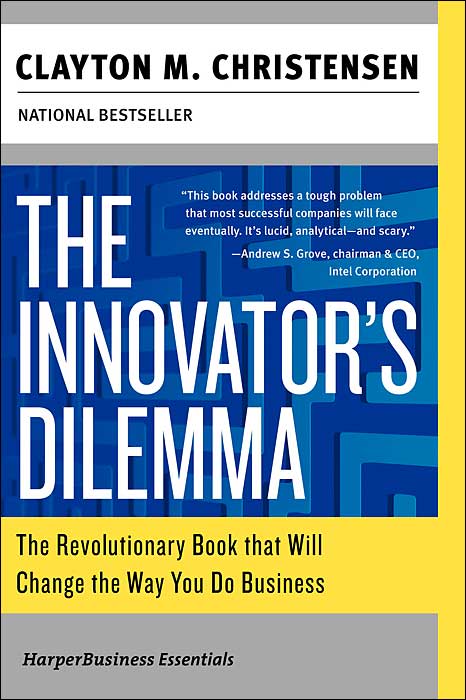
I was reading the book The Innovator's dilemma by Clayton M
Christensen, and came across some very interesting insights.
Technologists, in their zeal to attain the vertical limit,
successfully bring out goodies that are brilliant in nature and
acceptable by the market, but perhaps with features that the market
does not need at that point of time. That is the time when the market
evaluates the product from a different paradigm. And this new angle
can be quite devastating for the company.
Taking an example, when we came across Pentium IIs in 1997, they were
quite a rage. 400MHz was the speed many were looking for, and it
seemed that people would have more of it. And they did, with the
subsequent generations of Pentium IIIs and IVs, touching the current
max speed of 3.2GHz. There was a time when a two year old PC was
supposed to be outdated, for they were too slow for the current
applications. Internet demanded more memory and processing capacity,
and so the market was bullish on performance.
Today, I think my two-year old PC with Pentium IV 2.4GHz and 256 MB
RAM runs just fine as it did before. That's because my requirements
haven't changed. I still surf the net, the broadband has increased the
duration online, but the hardware needs are still the same. This is
the time when a 3.5 GHz, or 4 GHz processors will have a tepid
response in the PC market.
My job has required me to migrate from a PC to a thinkpad. I find this
Celeron notebook with just 1.5GHz CPU just fine for my work. Of course
they don't expect (or want) me to play games on this notebook. So if
you were to offer me a higher performance processor, will I be ready
to pay a premium for it? I don't think so.
At the moment, I would be looking at processors that don't heat up
much and consume less power. So my basis of evaluation has changed.
The book mentions about the product evaluation model by a needs
hierarchy. I found it really interesting, for I can relate to the
strategic ideas.
The market views a product in this order: functionality, reliability,
convenience and price.
When a new product is launched, the market will look at the features,
or its functionalities. I could take the example of mobile phones. Its
ability to keep one connected while on the move resulted in focus on
the functionality.
Reliability comes into picture when you have got the functionality you
were looking for, and you want something that does not conk off at
unexpected points.
Mobile handsets, having gotten over the functionality and reliability,
were being looked at for convenience (smaller, lighter, more battery
talktime and the like).
Finally, it all comes down to price. When the market has enough of the
above three, price remains the sole criterion. This is the time when
the product is said to have been commoditized. And commoditization
implies lower gross and profit margins for the company.
The success of a company comes from its ability to make profits. So
instead of looking solely at the functionality point of view, it makes
sense for the company to watch for the changing paradigms of the
market.
Tuesday, August 01, 2006
Music to the ears
As a comment on http://www.business-standard.com/strategist/storypage.php?tab=r&autono=98422&subLeft=3&leftnm=6
Last year there was this news of some 380 licences to be awarded to radio FM players, with the expectation that it would result in the burgeoning expansion of already existing radio FM business. It has, and continues to have its share of success. But going by the report this comment is based on, its badly commoditized to the extent that once cant really differenciate between stations, unless they re-iterate "You are listening to..blah blah blah". And with a break (which have badly increased in number), all people do is to swich channels hoping some other channel would be playing some a more palatable content.
This report talks about how Go 92.5 in Mumbai has revamped itself to Radio One, taking away its upscale image. I remember last year it played an interesting mix of Hindi and English music, and was my favorite. Unfortunately, those days are gone, for there aren't many listeners like me. At least not on the roads, on the local trains, in the shops. Subsequently, it seems it has been revamped to suit the junta, and has only found a place in the existing list of options that the daily commuters have on their little devices.
When worldspace was launched, I had serious doubts regarding its success. You need additional hardware, and licences which could mean an outflow of some Rs 5000. I neither had the moolah or the penchant for such exclusive music. Somehow it has found some place in some exclusive outlets, and now I don't find it an atrocious idea. It is a niche concept, and therefore commands a higher premium. And without ads, its actually music to the ears!!
Sunday, July 30, 2006
Lightening fast email?
You must have seen and smiled at the latest rediffmail ads comparing itself with the legendary hoohaa mail (we all know which is the control set), re-emphasizing its forgotten lightening fast competencies. I remember seeing rediff.com boards all around the city declaring itself to be the fastest one around. It did find a substantial share of free signups, but that was the turn of the last century.
Over the past 6 years, other primary email service providers have worked hard in revamping their image, and thanks to the increasing capacity of the ISPs, life is a lot better now. The new entrant, the 1998 born google came in with its platter of innovations, and flooded the market with its own version of email, the gmail. Too many renegades like me dumped the legendary rediff.com to embrace the new and promising technology. After all, in the absence of exit barriers, all that resists change is inertia.
This problem won’t be taken so well by the people who have options. Google has created a revolution of its won. And gmail is definitely incomparable. So where’s the competitive advantage for rediff?? The new outlook like interface may appeal to those with years of outlook experience (and works only with IE), but not too well with people who want hassle free service.
Sunday, July 23, 2006
Music to the ears??
As a comment on the business standard article
This report talks about how Go 92.5 in Mumbai has revamped itself to Radio One, taking away its upscale image. I remember last year it played an interesting mix of Hindi and English music, and was my favorite. Unfortunately, those days are gone, for there aren’t many listeners like me. At least not on the roads, on the local trains, in the shops. Subsequently, it seems it has been revamped to suit the junta, and has only found a place in the existing list of options that the daily commuters have on their little devices.
When worldspace was launched, I had serious doubts regarding its success. You need additional hardware, and licences which could mean an outflow of some Rs 5000. I neither had the moolah or the penchant for such exclusive music. Somehow it has found some place in some exclusive outlets, and now I don’t find it an atrocious idea. It is a niche concept, and therefore commands a higher premium. And without ads, its actually music to the ears!!
Thursday, March 09, 2006
Leading the revolution

While there are may books on innovation, there aren’t many that tells how to train your brain to innovate. I have been reading two classics back to back, both of which ask me to challenge the status quo. But have I?
I am talking about Gary Hamel’s Leading the Revolution and Kenichi Ohmae’s The mind of the strategist. I did find a lot of substance that actually made me think, and this process made me a fan of the two authors.
Gary Hamel opines that incremental innovations are no longer sufficient, they need to be replaced by revolutionary ones. Though the costs may not be humungous, only the ones having substance can survive. All good ideas are mocked at, and if an idea is instantly accepted, it may not be good enough!!
Hamel has given examples of real-life corporate rebels, such as John Patrick and David Grossman at IBM, Ken Kutaragi at Sony, and Georges Dupont-Roc at Shell. His message is the same to "old" and "new" companies alike: "Industry revolutionaries are like a missile up the tail pipe. Boom! You're irrelevant!" So join the revolution and avoid the explosion.
Its quite unputdownable, but given my time constraints, I need some time to finish it.
Tuesday, December 13, 2005
Which capital to manage?
Let us look at the definitions of market value and the book value.
Book Value = Assets – Liabilities
The market value is the perception, the gut feeling, the herd
mentality all rolled into one. While the former is more or less
stable, the latter is seeing turbulent times like never before. The
BSE SENSEX closed at over 9100 today. Which way are we going? Is this
another bubble waiting to burst, or is it an indicator of the GDP
growth that we are so gladly boasting of?
This post is not related to the rising sentiments, but something I
learnt about how the market values and book values of companies are
diverging. An article on Businessworld informed me that while the
share price of Infosys was pegged at around Rs 2650, its book value
was a mere Rs 192. Now this implies that some 93% are represented by
the intangibles!
This might be true with a software company, where knowledge as an
asset is not valued in the conventional terms. So as the price of
knowledge rises, so does the real value. A proper valuation of a
company like Infosys would give a totally different result.
Interestingly, an analysis S&P index of the US listed corporations
reveals that intangibles (market value – book value) have risen from
20% in 1980 to some 85% in 2000. this was possibly due to increased
emphasis on a service oriented economy.
India does not have a manufacturing legacy to boast of, and is now
going head over heals to tap the PPP difference between itself and the
west. The industry is getting more and more service oriented, and
these sectors are the ones that are attracting the best brains and
best growth patterns. Now that the proportion of intangibles is rising
should come at no surprise.
The author goes on to say that while capital management is looked at
as a way to bring in profitability for the company, the intellectual
capital (the intangibles) is often ignored.
The traditional systems are not effective in measuring intellectual
capital (IC). The valuation of these is a subjective affair. The
control of IC also gets difficult, especially in an industry infested
with high attrition rates.
But IC can be measured, and an IC rating is currently a matter of a
more elaborate discussion.
Monday, November 28, 2005
Breaking News
The news channels do not have any innovation, except while
manipulating facts. There is news breaking every hour. And if it is
so, why label them as breaking? All it would do (and has done) is to
get people ignore the breaking stuff and focus on news that did not go
broke! (pun intended)
While coming to office on my last day at Rallis, I found an
interesting article which mentioned about three events that got a lot
of media attention. To start with, what do Sania Mirza and Khushboo
have in common? The answer is very simple, both of them were condemned
by the moral police for saying things that are degrading to the 20000
year old culture and tradition.
Here comes the twist? What do the above two celebrities have in common
with the big B? that's not a question asked in any KBC, I know its
difficult. So his company ABCL also got condemned by the women
activists when Miss India celebrations were held in the garden city of
Bangalore way back in 1996.
There are more such analogies, you might say. But the most interesting
thing is that the protestors (or rather allegators!!) disappeared
after the brouhaha. Interesting, isn't it?
Now the facts: Protesting against the apparent abuse of the Indian
womanhood, the body of women was to set themselves ablaze if the event
happened in India. And as expected, security personnel including para
military forces were employed to keep the city under control. Naka
bandis every where, media went into a frenzy, and there were lots of
news breakages. At the end of it, no self immolation. The women
disappeared into the thin air. The miss world event did take place, at
the cost of creores, and this was billed to none other than ABCL.
There was no verification regarding the authenticity of the women, or
the cause they worked for.
Something similar happened in the recent Khushboo and Sania
controversy. Finally, it came out that it was a case of television
rivalry and a game of bad politics.
In sania's case, News and views apart, there was a good scope for
imagination. Disregarding the facts (read statements), someone's
imagination brought out reports that had little to do with Sania's
verdict.
What does this all lead to? Is it that we Indians are so gullible that
anyone can take us for a ride? Or is it that we worship the media, and
consider every word they utter as messages from God. And why do we
have to react on such breaking news, which have little fact behind
them?
Friday, November 25, 2005
Hide and seek
The hide and seek between SEBI and the foreign investors isnt a game, post the UBS securities scam. The FII acts as a proxy for the foreign investors, and uses the participartory note route. Participatory note, or p-note as they are called, are derivative instruments that have shares as their underlying. This makes them as volatile as the stock market.
The requirement of SEBI for the FII to disclose information on the investors has not gone well with the Know Your Client requirement, which fails to give a clear description of the requirements.
Now that the markets have a much higher penetration of foreign investors, it is a storehouse of another scam. The BSE Sensex today closed at 8861, which gives another wave of caution.
The Lahiri committee has recommended phasing out the PN route altogether in 3 years. It remains to be seen if, given the present circumstances, this is carried out.
The requirement of SEBI for the FII to disclose information on the investors has not gone well with the Know Your Client requirement, which fails to give a clear description of the requirements.
Now that the markets have a much higher penetration of foreign investors, it is a storehouse of another scam. The BSE Sensex today closed at 8861, which gives another wave of caution.
The Lahiri committee has recommended phasing out the PN route altogether in 3 years. It remains to be seen if, given the present circumstances, this is carried out.
Tuesday, November 22, 2005
GSM operators fail in QoS tests
As per this news on the Hindu Business Line, Airtel, Hutch and BPL mobile in Mumbai have failed in the TRAI tests for QoS. it came as a shock to me, because I had rated Airtel and Hutch high on the services. Unfortunately TRAI has higher standards then mine. There are regions were there no signal, for instance no the Chembur Vashi connector, but I had been taking it as acceptable!
I have always hated MTNL's mobile service, and I frown when anyone gives me a number beginning with 9869, because I know I would not be able to reach this person, in spite of this 10 digit numeral. No wonder that it was not considered for the QoS test!!
I have always hated MTNL's mobile service, and I frown when anyone gives me a number beginning with 9869, because I know I would not be able to reach this person, in spite of this 10 digit numeral. No wonder that it was not considered for the QoS test!!
Monday, November 21, 2005
The world is flat

You could say this guy (Thomas Friedman) is obsessed with globalization. First, the lexus and the Olive tree, and now its sequel, The world is flat. The flatness of the world comes from Narayana Murthy’s statement that we are on leveling grounds with the developed world. Ignoring the fact that the west complements the east in terms of working times, we in
The book starts with ‘aim at either Microsoft or IBM’. The author was asked to target one of the two IT conglomerates’ offices lying around a golf course in
Yes,
Having read some 20 pages with descriptions of
Friday, November 18, 2005
Whats your style?
While reading the book ‘Made in Japan Akio Morita and Sony’ I found something interesting. Probably it might sound clichéd, but there are vast differences between the Japanese and the American styles of management.
In
They believe in hierarchies, just the way one believes in levels in the family tree. The seniors are shown respect, and class differences are done away with. Rather, there are no castes or classes in
Akio Morita says that doing business in
So workers are affected by market conditions in
This observation puts me into another line of thought. What are we Indians good at? Termed as ‘basically lazy’, do we Indians measure up to the Japanese principals of camaraderie or results oriented American style? Perhaps neither. We prefer following the ‘middle path’ as advocated by Buddha.
So what philosophy do we follow? We follow whatever it suits our taste, our culture, our caste, our upbringing, our environment. Looking at anything outside our comfort zone is dangerous. At the end of the day, we are all happy because life mein sab chalta hai!!
Thursday, November 10, 2005
Five gas stations theory
I cannot stop appreciating the same book (Lexus and the Olive Tree). Today I learnt about the five gas stations theory. This is a story about five gas stations, owned by people from five different countries.
The first one is a Japanese gas station. It charges $5 a gallon and employs 4 people. These people tank up the gas, and wash your windows with a smile. They are friendly and you drive out with a smile on your face (achha lagta hai??)
The second is the American gas station. It charges $1 per gallon and has just one person. You fill the tank yourself, wash the windows yourself, fill the tyres yourself. And while you move out 4 homeless people try to steal your hubcaps.
The next station is the western European gas station. Gas costs $5 a gallon. There is one man on duty who pumps your gas, and changes your oil. But he doesn’t wash windows. He Works only thirty-five hours a week, with ninety minutes off each day for lunch, during which time the gas station is closed. He also has six weeks' vacation every summer in the south of France. Across the street, his two brothers and uncle, who have not worked in ten years because their state unemployment insurance pays more than their last job, are playing boccie ball.
Fourth is the developing-country gas station. Fifteen people work there and they are all cousins. When you drive in, no one pays any attention to you because they are all too busy talking to each other. Gas is only 35 cents a gallon because it is subsidized by the government, but only one of the six gas pumps actually works. The others are broken and they are waiting for the replacement parts to be flown in from Europe. The gas station is rather run-down because the absentee owner lives in Zurich and takes all the profits out of the country. The owner doesn't know that half his employees actually sleep in the repair shop at night and use the car wash equipment to shower. Most of the customers at the developing-country gas station either drive the latest-model Mercedes or a motor scooter nothing in between. This place is alway busy, though because so many people stop in to use the air pump to fill their bicycle tires.
Lastly there is the communist gas station. Gas there is only 50 cents a gallon -but there is none, because the four guys working there have sold it all on the black market for $5 a gallon. Just one of the four guys who is employed at the communist gas station is actually there. The other three are working at second jobs in the underground economy and come once a week to collect their paychecks.
This story (or theory, whatever you call it) portray the state of various economies that they represent. Japanese like togetherness, and follow and tend to reward equally. Prices are high (Tokyo is the most expensive city in the world), taxing those who can afford. They tend to reduce inequalities and move towards an equitable atmosphere. They guarantee lifetime employment, and then protect their markets from external attack.
The western Europeans tend to depend a lot on social security. Developing countries have high gap between the haves and the have nots. The middle class vanishes, and there are just two classes: the rich and the miserable. The Americans are market oriented, and would do everything to reduce costs, without providing anything called the social net. Performers are rewarded, turtles are fired.
Globalization has given rise to a market driven economy. Now everyone is moving towards capitalism, because socialism has failed.
The first one is a Japanese gas station. It charges $5 a gallon and employs 4 people. These people tank up the gas, and wash your windows with a smile. They are friendly and you drive out with a smile on your face (achha lagta hai??)
The second is the American gas station. It charges $1 per gallon and has just one person. You fill the tank yourself, wash the windows yourself, fill the tyres yourself. And while you move out 4 homeless people try to steal your hubcaps.
The next station is the western European gas station. Gas costs $5 a gallon. There is one man on duty who pumps your gas, and changes your oil. But he doesn’t wash windows. He Works only thirty-five hours a week, with ninety minutes off each day for lunch, during which time the gas station is closed. He also has six weeks' vacation every summer in the south of France. Across the street, his two brothers and uncle, who have not worked in ten years because their state unemployment insurance pays more than their last job, are playing boccie ball.
Fourth is the developing-country gas station. Fifteen people work there and they are all cousins. When you drive in, no one pays any attention to you because they are all too busy talking to each other. Gas is only 35 cents a gallon because it is subsidized by the government, but only one of the six gas pumps actually works. The others are broken and they are waiting for the replacement parts to be flown in from Europe. The gas station is rather run-down because the absentee owner lives in Zurich and takes all the profits out of the country. The owner doesn't know that half his employees actually sleep in the repair shop at night and use the car wash equipment to shower. Most of the customers at the developing-country gas station either drive the latest-model Mercedes or a motor scooter nothing in between. This place is alway busy, though because so many people stop in to use the air pump to fill their bicycle tires.
Lastly there is the communist gas station. Gas there is only 50 cents a gallon -but there is none, because the four guys working there have sold it all on the black market for $5 a gallon. Just one of the four guys who is employed at the communist gas station is actually there. The other three are working at second jobs in the underground economy and come once a week to collect their paychecks.
This story (or theory, whatever you call it) portray the state of various economies that they represent. Japanese like togetherness, and follow and tend to reward equally. Prices are high (Tokyo is the most expensive city in the world), taxing those who can afford. They tend to reduce inequalities and move towards an equitable atmosphere. They guarantee lifetime employment, and then protect their markets from external attack.
The western Europeans tend to depend a lot on social security. Developing countries have high gap between the haves and the have nots. The middle class vanishes, and there are just two classes: the rich and the miserable. The Americans are market oriented, and would do everything to reduce costs, without providing anything called the social net. Performers are rewarded, turtles are fired.
Globalization has given rise to a market driven economy. Now everyone is moving towards capitalism, because socialism has failed.
Wednesday, November 09, 2005
The winner takes it all
Continuing my tirade on the Lexus and the olive tree, it talks about
the widening difference between the haves and the have nots.
Undoubtedly we can see its effects in India as well. The gini index
precisely measures that. But the dangerous aspect is that with the
widening gap, it will not be long before the have nots revolt, leading
to a state of anarchy. It might just be round the corner.
The book, Freakonomics talked about why gangsters continue living with
their mothers, in spite of making a moolah on every endeavor. But the
fact remains that the distribution of the booty is far from uniform or
fair. It is highly skewed towards those at the top, leaving the bottom
in a state of despair. Their earnings are lesser than the minimum
wages stipulated by the US government. So why do they stick to such a
dangerous job? You call it greed or an aspiration, but everyone hopes
to be the leader some day and enjoy all the benefits.
The 80-20 principle is also based on the same lines. 80% of the
defects come from 20% of the materials. But the way we can improve the
bottom 20%, can we do that with people?
Thomas Friedman calls the bottom junta the turtles. This group
includes those used to all the security and predictability of life and
economy. Changes are resisted. But changes are happening, and they are
happening fast. The turtles, unlike the one in the hare and the turtle
story, lose out against the hares, who are smarter than the legendry
ones.
Golden arches theory
Thomas Friedman, in his book, Lexus and the olive tree has made an interesting theory based on capitalism, and has appropriately named it as the Golden arches theory. As per his theory, no two economies sustaining Mc Donalds franchisees will not go for war against each other. As a caveat, he excludes any civil wars in his definition. The basis of this proposition lies in the world’s constant move towards globalization. Post the cold war era, countries that have embraced globalization with open arms are the ones that are prospering, the others are moving towards embracing it. Sooner or later, all countries would become McDonald economies.
Probably that means that in order to avoid combat, open McDonald franchisees.
Did Ray Croc develop the golden arches with this in mind? Did he ever imagine that his business would someday be used as economic indicators? The Big Mac PPP exchange rate between two countries is obtained by dividing the cost of a Big Mac in one country (in its currency) by the cost of a Big Mac in another country (in its currency). This value is then compared with the actual exchange rate; if it is lower, then the first currency is under-valued (according to PPP theory) compared with the second, and conversely, if it is higher, then the first currency is over-valued.
Probably that means that in order to avoid combat, open McDonald franchisees.
Did Ray Croc develop the golden arches with this in mind? Did he ever imagine that his business would someday be used as economic indicators? The Big Mac PPP exchange rate between two countries is obtained by dividing the cost of a Big Mac in one country (in its currency) by the cost of a Big Mac in another country (in its currency). This value is then compared with the actual exchange rate; if it is lower, then the first currency is under-valued (according to PPP theory) compared with the second, and conversely, if it is higher, then the first currency is over-valued.
Friday, November 04, 2005
Reminiscence of Arthur Dunkel
Pascal Lamy, director general of the WTO gave the following speech on reminiscing the director General of GATT, Sir Arthur Dunkel. It is in the link below
http://www.wto.org/english/news_e/sppl_e/sppl13_e.htm
http://www.wto.org/english/news_e/sppl_e/sppl13_e.htm
Subscribe to:
Posts (Atom)