Sunday, August 27, 2006

Performance oversupply of technologies


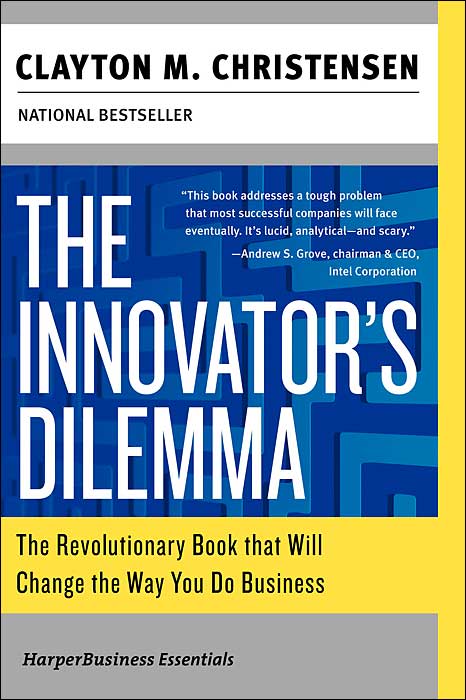
I was reading the book The Innovator's dilemma by Clayton M
Christensen, and came across some very interesting insights.

Technologists, in their zeal to attain the vertical limit,
successfully bring out goodies that are brilliant in nature and
acceptable by the market, but perhaps with features that the market
does not need at that point of time. That is the time when the market
evaluates the product from a different paradigm. And this new angle
can be quite devastating for the company.

Taking an example, when we came across Pentium IIs in 1997, they were
quite a rage. 400MHz was the speed many were looking for, and it
seemed that people would have more of it. And they did, with the
subsequent generations of Pentium IIIs and IVs, touching the current
max speed of 3.2GHz. There was a time when a two year old PC was
supposed to be outdated, for they were too slow for the current
applications. Internet demanded more memory and processing capacity,
and so the market was bullish on performance.

Today, I think my two-year old PC with Pentium IV 2.4GHz and 256 MB
RAM runs just fine as it did before. That's because my requirements
haven't changed. I still surf the net, the broadband has increased the
duration online, but the hardware needs are still the same. This is
the time when a 3.5 GHz, or 4 GHz processors will have a tepid
response in the PC market.

My job has required me to migrate from a PC to a thinkpad. I find this
Celeron notebook with just 1.5GHz CPU just fine for my work. Of course
they don't expect (or want) me to play games on this notebook. So if
you were to offer me a higher performance processor, will I be ready
to pay a premium for it? I don't think so.

At the moment, I would be looking at processors that don't heat up
much and consume less power. So my basis of evaluation has changed.

The book mentions about the product evaluation model by a needs
hierarchy. I found it really interesting, for I can relate to the
strategic ideas.

The market views a product in this order: functionality, reliability,
convenience and price.
When a new product is launched, the market will look at the features,
or its functionalities. I could take the example of mobile phones. Its
ability to keep one connected while on the move resulted in focus on
the functionality.
Reliability comes into picture when you have got the functionality you
were looking for, and you want something that does not conk off at
unexpected points.
Mobile handsets, having gotten over the functionality and reliability,
were being looked at for convenience (smaller, lighter, more battery
talktime and the like).
Finally, it all comes down to price. When the market has enough of the
above three, price remains the sole criterion. This is the time when
the product is said to have been commoditized. And commoditization
implies lower gross and profit margins for the company.

The success of a company comes from its ability to make profits. So
instead of looking solely at the functionality point of view, it makes
sense for the company to watch for the changing paradigms of the
market.

Tuesday, August 01, 2006

Music to the ears

As a comment on http://www.business-standard.com/strategist/storypage.php?tab=r&autono=98422&subLeft=3&leftnm=6

Last year there was this news of some 380 licences to be awarded to radio FM players, with the expectation that it would result in the burgeoning expansion of already existing radio FM business. It has, and continues to have its share of success. But going by the report this comment is based on, its badly commoditized to the extent that once cant really differenciate between stations, unless they re-iterate "You are listening to..blah blah blah". And with a break (which have badly increased in number), all people do is to swich channels hoping some other channel would be playing some a more palatable content.

This report talks about how Go 92.5 in Mumbai has revamped itself to Radio One, taking away its upscale image. I remember last year it played an interesting mix of Hindi and English music, and was my favorite. Unfortunately, those days are gone, for there aren't many listeners like me. At least not on the roads, on the local trains, in the shops. Subsequently, it seems it has been revamped to suit the junta, and has only found a place in the existing list of options that the daily commuters have on their little devices.

When worldspace was launched, I had serious doubts regarding its success. You need additional hardware, and licences which could mean an outflow of some Rs 5000. I neither had the moolah or the penchant for such exclusive music. Somehow it has found some place in some exclusive outlets, and now I don't find it an atrocious idea. It is a niche concept, and therefore commands a higher premium. And without ads, its actually music to the ears!!

Sunday, July 30, 2006

Lightening fast email?

You must have seen and smiled at the latest rediffmail ads comparing itself with the legendary hoohaa mail (we all know which is the control set), re-emphasizing its forgotten lightening fast competencies. I remember seeing rediff.com boards all around the city declaring itself to be the fastest one around. It did find a substantial share of free signups, but that was the turn of the last century.

Over the past 6 years, other primary email service providers have worked hard in revamping their image, and thanks to the increasing capacity of the ISPs, life is a lot better now. The new entrant, the 1998 born google came in with its platter of innovations, and flooded the market with its own version of email, the gmail. Too many renegades like me dumped the legendary rediff.com to embrace the new and promising technology. After all, in the absence of exit barriers, all that resists change is inertia.

Though I have kept my rediffmail account (had passed on this email id at the times when slam books were a norm), the worst thing about rediffmail is that you have too many messages welcoming you every time you log in. unfortunately its not your fan mail, but mails from wannabe fans. And fans that want your business, whether you want their service or not. It may be argued that there are downsides of free services, so if you want a better spam free email, upgrade to rediff pro (and pay an annual fee)

This problem won’t be taken so well by the people who have options. Google has created a revolution of its won. And gmail is definitely incomparable. So where’s the competitive advantage for rediff?? The new outlook like interface may appeal to those with years of outlook experience (and works only with IE), but not too well with people who want hassle free service.

Sunday, July 23, 2006

Music to the ears??

As a comment on the business standard article

Last year there was this news (my post) of some 330 licences to be awarded to radio FM players, with the expectation that it would result in the burgeoning expansion of already existing radio FM business. It has, and continues to have its share of success. But going by the report this comment is based on, its badly commoditized to the extent that once cant really differenciate between stations, unless they re-iterate “You are listening to..blah blah blah”. And with a break (which have badly increased in number), all people do is to swich channels hoping some other channel would be playing some a more palatable content.


This report talks about how Go 92.5 in Mumbai has revamped itself to Radio One, taking away its upscale image. I remember last year it played an interesting mix of Hindi and English music, and was my favorite. Unfortunately, those days are gone, for there aren’t many listeners like me. At least not on the roads, on the local trains, in the shops. Subsequently, it seems it has been revamped to suit the junta, and has only found a place in the existing list of options that the daily commuters have on their little devices.

When worldspace was launched, I had serious doubts regarding its success. You need additional hardware, and licences which could mean an outflow of some Rs 5000. I neither had the moolah or the penchant for such exclusive music. Somehow it has found some place in some exclusive outlets, and now I don’t find it an atrocious idea. It is a niche concept, and therefore commands a higher premium. And without ads, its actually music to the ears!!

Thursday, March 09, 2006

Leading the revolution


While there are may books on innovation, there aren’t many that tells how to train your brain to innovate. I have been reading two classics back to back, both of which ask me to challenge the status quo. But have I?

I am talking about Gary Hamel’s Leading the Revolution and Kenichi Ohmae’s The mind of the strategist. I did find a lot of substance that actually made me think, and this process made me a fan of the two authors.

Gary Hamel opines that incremental innovations are no longer sufficient, they need to be replaced by revolutionary ones. Though the costs may not be humungous, only the ones having substance can survive. All good ideas are mocked at, and if an idea is instantly accepted, it may not be good enough!!

Hamel has given examples of real-life corporate rebels, such as John Patrick and David Grossman at IBM, Ken Kutaragi at Sony, and Georges Dupont-Roc at Shell. His message is the same to "old" and "new" companies alike: "Industry revolutionaries are like a missile up the tail pipe. Boom! You're irrelevant!" So join the revolution and avoid the explosion.

Its quite unputdownable, but given my time constraints, I need some time to finish it.

Tuesday, December 13, 2005

Which capital to manage?

Let us look at the definitions of market value and the book value.

Book Value = Assets – Liabilities

The market value is the perception, the gut feeling, the herd
mentality all rolled into one. While the former is more or less
stable, the latter is seeing turbulent times like never before. The
BSE SENSEX closed at over 9100 today. Which way are we going? Is this
another bubble waiting to burst, or is it an indicator of the GDP
growth that we are so gladly boasting of?

This post is not related to the rising sentiments, but something I
learnt about how the market values and book values of companies are
diverging. An article on Businessworld informed me that while the
share price of Infosys was pegged at around Rs 2650, its book value
was a mere Rs 192. Now this implies that some 93% are represented by
the intangibles!

This might be true with a software company, where knowledge as an
asset is not valued in the conventional terms. So as the price of
knowledge rises, so does the real value. A proper valuation of a
company like Infosys would give a totally different result.

Interestingly, an analysis S&P index of the US listed corporations
reveals that intangibles (market value – book value) have risen from
20% in 1980 to some 85% in 2000. this was possibly due to increased
emphasis on a service oriented economy.

India does not have a manufacturing legacy to boast of, and is now
going head over heals to tap the PPP difference between itself and the
west. The industry is getting more and more service oriented, and
these sectors are the ones that are attracting the best brains and
best growth patterns. Now that the proportion of intangibles is rising
should come at no surprise.

The author goes on to say that while capital management is looked at
as a way to bring in profitability for the company, the intellectual
capital (the intangibles) is often ignored.

The traditional systems are not effective in measuring intellectual
capital (IC). The valuation of these is a subjective affair. The
control of IC also gets difficult, especially in an industry infested
with high attrition rates.

But IC can be measured, and an IC rating is currently a matter of a
more elaborate discussion.

Monday, November 28, 2005

Breaking News

The news channels do not have any innovation, except while
manipulating facts. There is news breaking every hour. And if it is
so, why label them as breaking? All it would do (and has done) is to
get people ignore the breaking stuff and focus on news that did not go
broke! (pun intended)

While coming to office on my last day at Rallis, I found an
interesting article which mentioned about three events that got a lot
of media attention. To start with, what do Sania Mirza and Khushboo
have in common? The answer is very simple, both of them were condemned
by the moral police for saying things that are degrading to the 20000
year old culture and tradition.

Here comes the twist? What do the above two celebrities have in common
with the big B? that's not a question asked in any KBC, I know its
difficult. So his company ABCL also got condemned by the women
activists when Miss India celebrations were held in the garden city of
Bangalore way back in 1996.

There are more such analogies, you might say. But the most interesting
thing is that the protestors (or rather allegators!!) disappeared
after the brouhaha. Interesting, isn't it?

Now the facts: Protesting against the apparent abuse of the Indian
womanhood, the body of women was to set themselves ablaze if the event
happened in India. And as expected, security personnel including para
military forces were employed to keep the city under control. Naka
bandis every where, media went into a frenzy, and there were lots of
news breakages. At the end of it, no self immolation. The women
disappeared into the thin air. The miss world event did take place, at
the cost of creores, and this was billed to none other than ABCL.
There was no verification regarding the authenticity of the women, or
the cause they worked for.

Something similar happened in the recent Khushboo and Sania
controversy. Finally, it came out that it was a case of television
rivalry and a game of bad politics.

In sania's case, News and views apart, there was a good scope for
imagination. Disregarding the facts (read statements), someone's
imagination brought out reports that had little to do with Sania's
verdict.

What does this all lead to? Is it that we Indians are so gullible that
anyone can take us for a ride? Or is it that we worship the media, and
consider every word they utter as messages from God. And why do we
have to react on such breaking news, which have little fact behind
them?

Friday, November 25, 2005

Hide and seek

The hide and seek between SEBI and the foreign investors isnt a game, post the UBS securities scam. The FII acts as a proxy for the foreign investors, and uses the participartory note route. Participatory note, or p-note as they are called, are derivative instruments that have shares as their underlying. This makes them as volatile as the stock market.

The requirement of SEBI for the FII to disclose information on the investors has not gone well with the Know Your Client requirement, which fails to give a clear description of the requirements.

Now that the markets have a much higher penetration of foreign investors, it is a storehouse of another scam. The BSE Sensex today closed at 8861, which gives another wave of caution.

The Lahiri committee has recommended phasing out the PN route altogether in 3 years. It remains to be seen if, given the present circumstances, this is carried out.

Tuesday, November 22, 2005

GSM operators fail in QoS tests

As per this news on the Hindu Business Line, Airtel, Hutch and BPL mobile in Mumbai have failed in the TRAI tests for QoS. it came as a shock to me, because I had rated Airtel and Hutch high on the services. Unfortunately TRAI has higher standards then mine. There are regions were there no signal, for instance no the Chembur Vashi connector, but I had been taking it as acceptable!

I have always hated MTNL's mobile service, and I frown when anyone gives me a number beginning with 9869, because I know I would not be able to reach this person, in spite of this 10 digit numeral. No wonder that it was not considered for the QoS test!!

Monday, November 21, 2005

The world is flat


You could say this guy (Thomas Friedman) is obsessed with globalization. First, the lexus and the Olive tree, and now its sequel, The world is flat. The flatness of the world comes from Narayana Murthy’s statement that we are on leveling grounds with the developed world. Ignoring the fact that the west complements the east in terms of working times, we in India have reached the standard that the west just cannot ignore.

The book starts with ‘aim at either Microsoft or IBM’. The author was asked to target one of the two IT conglomerates’ offices lying around a golf course in Bangalore. Surrounded by American firms’ offices (includes Goldman Sachs too), and consumables (Pizza Hut), it really gets into me a feeling of awe. Is this our India?

Yes, India has changed. From the developing economy to a galloping one. it gives an image of India in the pre-Columbus era. And in fact, Friedman compares himself with Columbus, only that he is just 500 years younger. Columbus wanted to discover India and found America, and thought he was in India. Our author had little trouble finding the geographical India, but found people who looked more American than Indian.

Bangalore has a good number of 20 somethings working at call centers, catering to the American clientele. Their accents have changed, and they don’t mind getting their accents raked up for the sake of some hard cash. They yearn to be out of their middle class barriers. Some of these are earning more than their fathers earned at the time of retirement!

Having read some 20 pages with descriptions of India, I am wondering if this has been written by an Indian. But this has a world appeal, and I hope to get further insights into the development of the globalized world in the 21st century!!

Friday, November 18, 2005

Whats your style?

While reading the book ‘Made in Japan Akio Morita and Sony’ I found something interesting. Probably it might sound clichéd, but there are vast differences between the Japanese and the American styles of management.

In Japan, working for an organization is (or at least was) supposed to be your religion, your faith, your second home. Your workplace is supposed to be your extended family where all junior and senior members live like a happy family. In times of crisis, everyone works hard for the company. There need not be any compulsion or seduction for the commitment. It comes naturally. Probably that’s the reason why Japan came out from being the most devastated country post world war to one of the richest.

They believe in hierarchies, just the way one believes in levels in the family tree. The seniors are shown respect, and class differences are done away with. Rather, there are no castes or classes in Japan, as per the Sony founder. The people share the resources (these were in short supply post world war), and come together, working up to 16-18 hours per day, only to bring their country up to its former glory. He says that executives did not have a private space, and they managed collectively.

Akio Morita says that doing business in America was quite a different scenario. There was hardly anything similar. He cites two examples to state his surprise. In the first, one person would not perform in spite of repeated trainings and incentives. He had not even thought of firing him, because it was a rarity in Japan, where lifetime employment was a commonplace. The second example is at the opposite side. A consistent performer, having received lots of perks left Sony to join a competitor, because it offered a salary he could not refuse. But he (Morita terms him as the traitor!) did have the audacity to meet him later and show him around at a fair. This was a major deviation from the Japanese style of management.

So workers are affected by market conditions in America, while the keiretsus bear the brunt in Japan. The risk has to be passed somewhere!

This observation puts me into another line of thought. What are we Indians good at? Termed as ‘basically lazy’, do we Indians measure up to the Japanese principals of camaraderie or results oriented American style? Perhaps neither. We prefer following the ‘middle path’ as advocated by Buddha.

So what is our style? Post independence, we made good friends with Russia, since our leaders were more comfortable with the socialist kind of attitude. Democracy was installed, and we made a mockery of it, with a majority of the population not even functionally literate. With the rise of America as the new superpower and the Collapse of Russia, we had to support American style, pop, pizzas (I think someone told me pizza is Italian!), colas and all commodities flooding the Indian markets. Globalization is the new keyword, and every Tom and his neighbor embrace it, for that is in vogue. Our PSUs are abodes of lethargy and inefficiency, food is a constant problem, and agriculture has taken a backseat.

So what philosophy do we follow? We follow whatever it suits our taste, our culture, our caste, our upbringing, our environment. Looking at anything outside our comfort zone is dangerous. At the end of the day, we are all happy because life mein sab chalta hai!!

Thursday, November 10, 2005

Five gas stations theory

I cannot stop appreciating the same book (Lexus and the Olive Tree). Today I learnt about the five gas stations theory. This is a story about five gas stations, owned by people from five different countries.

The first one is a Japanese gas station. It charges $5 a gallon and employs 4 people. These people tank up the gas, and wash your windows with a smile. They are friendly and you drive out with a smile on your face (achha lagta hai??)

The second is the American gas station. It charges $1 per gallon and has just one person. You fill the tank yourself, wash the windows yourself, fill the tyres yourself. And while you move out 4 homeless people try to steal your hubcaps.

The next station is the western European gas station. Gas costs $5 a gallon. There is one man on duty who pumps your gas, and changes your oil. But he doesn’t wash windows. He Works only thirty-five hours a week, with ninety minutes off each day for lunch, during which time the gas station is closed. He also has six weeks' vacation every summer in the south of France. Across the street, his two brothers and uncle, who have not worked in ten years because their state unemployment insurance pays more than their last job, are playing boccie ball.

Fourth is the developing-country gas station. Fifteen people work there and they are all cousins. When you drive in, no one pays any attention to you because they are all too busy talking to each other. Gas is only 35 cents a gallon because it is subsidized by the government, but only one of the six gas pumps actually works. The others are broken and they are waiting for the replacement parts to be flown in from Europe. The gas station is rather run-down because the absentee owner lives in Zurich and takes all the profits out of the country. The owner doesn't know that half his employees actually sleep in the repair shop at night and use the car wash equipment to shower. Most of the customers at the developing-country gas station either drive the latest-model Mercedes or a motor scooter nothing in between. This place is alway busy, though because so many people stop in to use the air pump to fill their bicycle tires.

Lastly there is the communist gas station. Gas there is only 50 cents a gallon -but there is none, because the four guys working there have sold it all on the black market for $5 a gallon. Just one of the four guys who is employed at the communist gas station is actually there. The other three are working at second jobs in the underground economy and come once a week to collect their paychecks.

This story (or theory, whatever you call it) portray the state of various economies that they represent. Japanese like togetherness, and follow and tend to reward equally. Prices are high (Tokyo is the most expensive city in the world), taxing those who can afford. They tend to reduce inequalities and move towards an equitable atmosphere. They guarantee lifetime employment, and then protect their markets from external attack.

The western Europeans tend to depend a lot on social security. Developing countries have high gap between the haves and the have nots. The middle class vanishes, and there are just two classes: the rich and the miserable. The Americans are market oriented, and would do everything to reduce costs, without providing anything called the social net. Performers are rewarded, turtles are fired.

Globalization has given rise to a market driven economy. Now everyone is moving towards capitalism, because socialism has failed.

Wednesday, November 09, 2005

The winner takes it all

Continuing my tirade on the Lexus and the olive tree, it talks about
the widening difference between the haves and the have nots.
Undoubtedly we can see its effects in India as well. The gini index
precisely measures that. But the dangerous aspect is that with the
widening gap, it will not be long before the have nots revolt, leading
to a state of anarchy. It might just be round the corner.

The book, Freakonomics talked about why gangsters continue living with
their mothers, in spite of making a moolah on every endeavor. But the
fact remains that the distribution of the booty is far from uniform or
fair. It is highly skewed towards those at the top, leaving the bottom
in a state of despair. Their earnings are lesser than the minimum
wages stipulated by the US government. So why do they stick to such a
dangerous job? You call it greed or an aspiration, but everyone hopes
to be the leader some day and enjoy all the benefits.

The 80-20 principle is also based on the same lines. 80% of the
defects come from 20% of the materials. But the way we can improve the
bottom 20%, can we do that with people?

Thomas Friedman calls the bottom junta the turtles. This group
includes those used to all the security and predictability of life and
economy. Changes are resisted. But changes are happening, and they are
happening fast. The turtles, unlike the one in the hare and the turtle
story, lose out against the hares, who are smarter than the legendry
ones.

Golden arches theory

Thomas Friedman, in his book, Lexus and the olive tree has made an interesting theory based on capitalism, and has appropriately named it as the Golden arches theory. As per his theory, no two economies sustaining Mc Donalds franchisees will not go for war against each other. As a caveat, he excludes any civil wars in his definition. The basis of this proposition lies in the world’s constant move towards globalization. Post the cold war era, countries that have embraced globalization with open arms are the ones that are prospering, the others are moving towards embracing it. Sooner or later, all countries would become McDonald economies.

Probably that means that in order to avoid combat, open McDonald franchisees.

Did Ray Croc develop the golden arches with this in mind? Did he ever imagine that his business would someday be used as economic indicators? The Big Mac PPP exchange rate between two countries is obtained by dividing the cost of a Big Mac in one country (in its currency) by the cost of a Big Mac in another country (in its currency). This value is then compared with the actual exchange rate; if it is lower, then the first currency is under-valued (according to PPP theory) compared with the second, and conversely, if it is higher, then the first currency is over-valued.

Friday, November 04, 2005

Reminiscence of Arthur Dunkel

Pascal Lamy, director general of the WTO gave the following speech on reminiscing the director General of GATT, Sir Arthur Dunkel. It is in the link below

http://www.wto.org/english/news_e/sppl_e/sppl13_e.htm

Globalization

There are proponents of globalization and there are opponents. Love it or hate it, but one just cant ignore its presence and the way it has affected the world post the cold war era. Closed economies could not afford to stay that way, and the current resurgence of growth is primarily due to the open economy.

The next month’s WTO meet at Hong Kong would be decisive in many factors. The major issues would be the farm subsidies present in France and other EU countries, and the IPR issues.

Interestingly, India and the US will co-chair a 14-member special group on services negotiations, a move aimed at giving a boost to WTO.

Ideas from:

http://www.economist.com/displaystory.cfm?story_id=5115177

http://www.financialexpress.com/fe_full_story.php?content_id=104235

http://www.rediff.com/money/2005/feb/22wto.htm

Monday, October 31, 2005

Airtel – Hutch = 46000 crore!!

It sounds surprising, though. Comparative valuations of the two
companies reveals that bharti has been valued by Vodafone at Rs 67000
crore, while Hutch at just 21000 crore. Interesting is the fact that
while Bharti has a subscriber base of 14 million, hutch has a base of
11 million. The difference is due to the fact that Bharti, with its
Airtel brand is into fixed lines, is a NLD (national long distance)
service provider, ILD (International long distance) provider and a
Broadband provider as well.

The increase in FDI provision to 74% in telecom has been well tapped
by Bharti. Its current acquisition targets include Spice and Aircel.
If it gets these, the move could largely marginalize hutch and other
smaller mobile service providers.

Information souce: Economic Times, 31 Oct 2005

The Lexus and the Olive Tree


If you want to know how the fall of the Berlin wall brought an end to the cold war era and gave a fresh life to the world, if you want to know how the national borders are diminishing, there is no threshold any more and that the world is moving towards higher efficiency, read this book by Thomas Friedman.

Undoubtedly, it gives a fantastic insight of how the globalised world has progressed, taking a re-birth post the cold war era. A lot of us would be surprised to know that prior to 1920, globalization did exist, but not in the embodiment we know it today. Undoubtedly the microchip had not seen the light of the day, and people moved goods (the stock, in Adam Smith’s parlance). But today it’s information that needs an efficient transfer. The book talks about information arbitrage, not unlike the one done in the financial markets.

Just as Dayanidhi maran is moving towards ‘one India’ in making telecom policies, the world would move towards ‘one economy’ erasing boundaries my means of M&As in the process. Currently hostile takeovers would be objected by the UNO, and friendly mergers are quite surreal. But it might not be long before it happens, if we are to give up our olive trees and adopt the Lexus is return!!

Friday, October 28, 2005

Are you ready to pay tax?

In response to http://www.financialexpress.com/latest_full_story.php?content_id=107039&pn=1

Its queer to know that just about 3% of our 100 billion plus population pay taxes, and collection rate is just about 10% of GDP. But what gives the people the audacity to avoid paying taxes? Looking at it objectively, I can think of

  • Inefficient tracking system
  • Corrupt officials
  • Slow judicial system
  • Law loopholes
  • Lack of faith in the politicians running the government
  • Demotivating to find 97% of the population not paying tax

The government's plan to send sms's is a novel idea to exploit technology; it was quite effectively done during the july 26 rains, when messages from the police commissioner were circulated to all mobile users in Mumbai. But I don't see how an individual can hold his head high by paying taxes. With the kind of collection system in place, there is hardly anyone who cares if his neighbour and his uncle are paying taxes or not. All they know is what they hold in possession.

Our agrarian economy does not allow us to collect taxes from the farmers. Unfortunately, there are those who end up making mansions with the agricultural produce, without paying taxes. A majority of our transactions take place by cash, thereby blurring any kind of tracking system.

Monday, October 24, 2005

Gini index

In response to http://economictimes.indiatimes.com/articleshow/1272191.cms

In the world of economists, the indexes are commonplace. Comparison of
the disparity between the rich and the poor is well represented by the
Gini index. Statistically, these valuations hold greater significance
with the rise in the sample size. And it makes such indexes harder to
move. The widely publicized growth rates have little to do to the
population in the remote areas, where many are still in want of water
and food supplies. Money does have a cascading effect, and in spite of
the socialist philosophies of the creators of the constitution, we are
going towards the philosophy that has worked wonders: capitalism. Our
communist strategies have not worked, this is evident in the state if
west Bengal. A high population makes things difficult. Education is
the key to any kind of development.